

This is the best training split you’ve probably never heard of.
Most guys run splits like Push Pull Legs, Upper Lower, or Full Body. But none of these structures leave room for speed, violent explosive power, building an elite gas tank, or developing skill in a sport, martial arts, tennis, swimming, running, you name it.
You pigeonhole yourself into a training system built purely around adding muscle, which in 2026 is a one dimensional pursuit.
I’ve run every split on that list myself. Push Pull Legs, Upper Lower, Full Body, all of it. And every single time, I felt tired, slow, and like my nervous system and tendons never had the chance to recover, because I was trying to bolt a dozen other physical qualities onto a system that was never designed to hold them.
It’s the same feedback I hear from nearly every client the moment they start working with me. They feel beat up. Stiff. Sore, permanently, from a traditional bodybuilding split that was never built to support anything beyond itself. And the second they try to start running, pick up a sport, or do anything other than build muscle, that soreness compounds into something closer to breakdown.
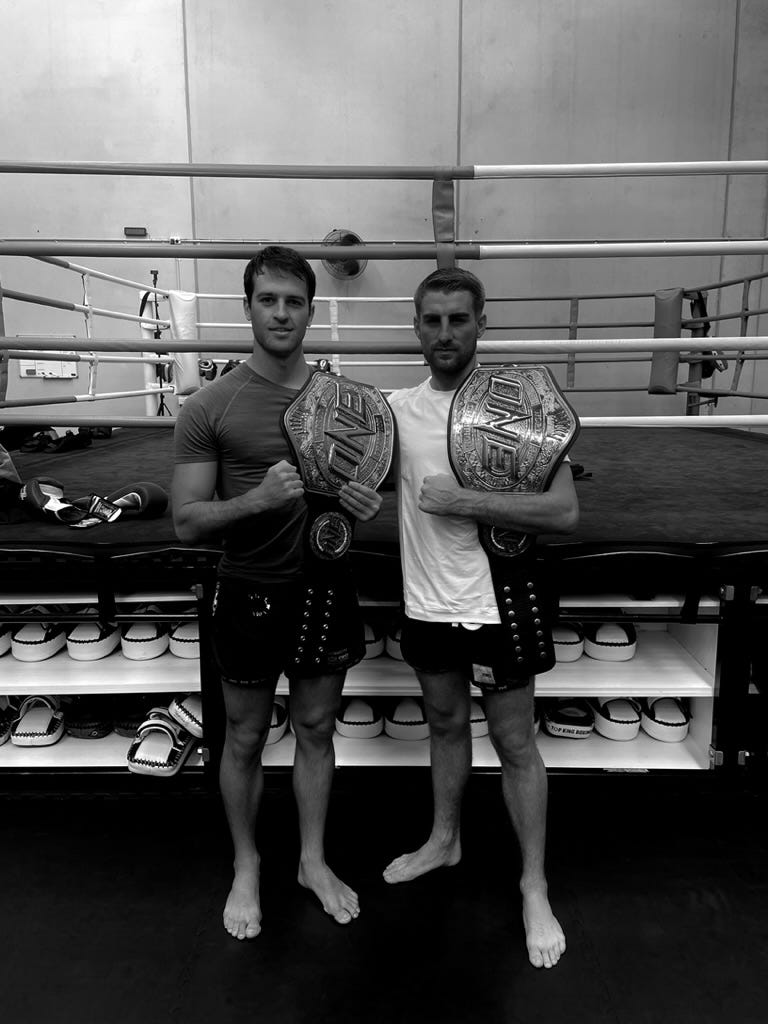
It wasn’t until I started studying what the best athletes on the planet were actually doing, guys like Jonathan Haggerty, Anthony Joshua and Alex Volkanovski… These men have millions on the line for their performance to be on point.
And they structure their training completely differently to the general public.
Their entire training system is built around 1 primary focus.
The nervous system.
NERVOUS SYTEM FOCUSED TRAINING SPLITS
The first time I started training with respect to the nervous system, I got injured far less frequently, got sick less often and was able to improve my training performance week on week.
If you’re like myself, and are not taking PEDs such as GH , Test/ TRT, you can’t recover the same way as these fake natural influencers you see on social media.
You have to respect your body and recovery timelines, otherwise you will eventually break.
The best way to do this, is categorising your training in this exact way:
HIGH STRESS DAYS

These are the training sessions that are the most taxing on the nervous system, and take approximately 48 hours to recover effectively from without impacting performance.
These are some examples of high stress training sessions:
MMA Sparring
Lower Body Training (Strength / Hypertrophy)
Sprint Training
Threshold or Zone 3+ Training Sessions
Maximal Jumps and Intensive Plyometrics
It is highly advisable not to complete these sessions on back to back days, as your risk of injury spikes, and your performance in these sessions greatly diminishes.
LOW STRESS DAYS

These are training sessions that are far less taxing on the body, and do not have as high of a recovery cost.
Some examples of these sessions:
Long walks
Z1-Z2 Jogging (depending on your level of fitness)
Mobility and Flexibility Training
Moderate Volume Upper Body Sessions
Low Intensity skill training (tennis, golf, martial arts, you name it)
Drills and skill acquisition work (has to be done fresh to actually have the skills you develop ‘stick’).
THERE IS NUANCE HERE
Now, the list I gave you is far from exhaustive, and a typically ‘low stress session’ can absolutely be a high stress day.
For example if you’re doing a very high volume upper body session or a 2 hour long run, these no longer become a low stress day (you have to use your brain and look at the nuance of each situation).
This is something I will track with my clients who use HRV data and recoverability data, or simply getting a gauge of their fitness.
A 30 minute easy run for 1 client, might be a zone 3 run for another, which is exactly why a custom training process is so valuable (you can learn about how I consult clients here).
SETTING UP AN ANABOLIC TRAINING SPLIT
Instead of focusing on isolating muscle groups, you can use the same system I built the Lethal Physique Protocol with…
STEP 1: ALLOCATE HIGH STRESS SESSIONS FIRST
For anyone first using this system, Start by allocating 2 high stress days per week to begin with. Select one of the session types above, you can also check out the lethal physique protocol for a lower body training session that blends raw strength, explosive power, muscle development and durability into 2 sessions per week.
This is a recommended foundation before extended to 3 high stress days per week.
STEP 2: ALLOCATE LOW STRESS DAYS IMMEDIATE AFTER
Place a low stress day, on the day immediately after your high stress work.
If Monday is Muay Thai sparring, Tuesday should be mobility, a long walk, a zone 1 or 2 jog, these are all examples, but always be more on the conservative side when selecting your low stress sessions (particularly if you don’t have a lot of training experience).
STEP 3: TRACK YOUR RECOVERY
This can be done either by listening to how your body feels after running a structure like this for 4 weeks.
For the more dedicated you can measure your HRV with a heart rate strap each morning (whoop and oura HRV is extremely inaccurate that I won’t use it for any meaningful data).
You will see how much better your HRV, recovery, rate of illness and injury minimisation is, simply from better structuring your weekly training split from a more traditional bodybuilding style, to the anabolic split I just showed you.
Once again, if you want a crystal clear system to setup your anabolic training sessions, coupled with my performance nutrition systems, I’m giving early access to my substack members before I raise the price in a few weeks.
This was popularised by Charlie Francis w/ Ben Johnson, would recommend Speed Trap!
Good read! As a rugby athlete I have noticed the high/low split is becoming popular as it accounts for gamedays. JT Performance on instagram is a good resource as well as this. Cheers JK.